
Introduction
Have you ever wondered how Google seems to know exactly what you’re looking for? You type a question into the search bar, and within seconds, it shows the most relevant results. It may feel like magic, but behind the scenes, powerful SEO systems are working to match your query with the best content.
If you run a website or blog, understanding this process is essential. This is where Google SEO basics come in. SEO (Search Engine Optimization) helps search engines understand your content so they can show it to the right audience at the right time.
By mastering Google SEO basics, you can improve your website’s visibility, increase your click-through rate (CTR), and attract highly targeted organic traffic. These are visitors who are actively searching for what you offer, which improves user behavior signals like engagement, time on site, and conversions.
👉 New to SEO? Start with this simple beginner guide:
https://bigyankhadkacom.com/seo-for-beginners/
This is not just about rankings. It’s about creating high-quality content, using the right keywords, and building a website that both users and search engines trust. Over time, this leads to better rankings, stronger authority, and natural backlinks.
In this beginner-friendly guide, you will learn how search engines work, including crawling, indexing, and ranking. You will also discover practical SEO strategies you can apply today to start growing your website and building long-term success.
What is SEO and Why It Matters
Before diving into the “how,” let’s clarify the “what.” SEO is the process of improving your website to increase its visibility in search engine results pages (SERPs). When someone searches for a topic related to your content, you want your page to appear as high as possible on the first page of Google.
Think about it: when was the last time you clicked through to page two or three of Google results? Most people never do. That’s why ranking well is so important.
Benefits of SEO
- Organic Traffic: Get visitors who find you naturally, without paying for ads.
- Authority & Trust: High-ranking sites are seen as trustworthy.
- Long-term Strategy: SEO builds consistent traffic over months and years.
- Better User Experience: SEO improvements often enhance usability and speed.
Mastering Google SEO basics is an investment in your website’s long-term growth.
👉 Learn keyword research for beginners step by step here:
https://bigyankhadkacom.com/keyword-research-for-beginners/
How Search Engines Work: The Core of Google SEO Basics
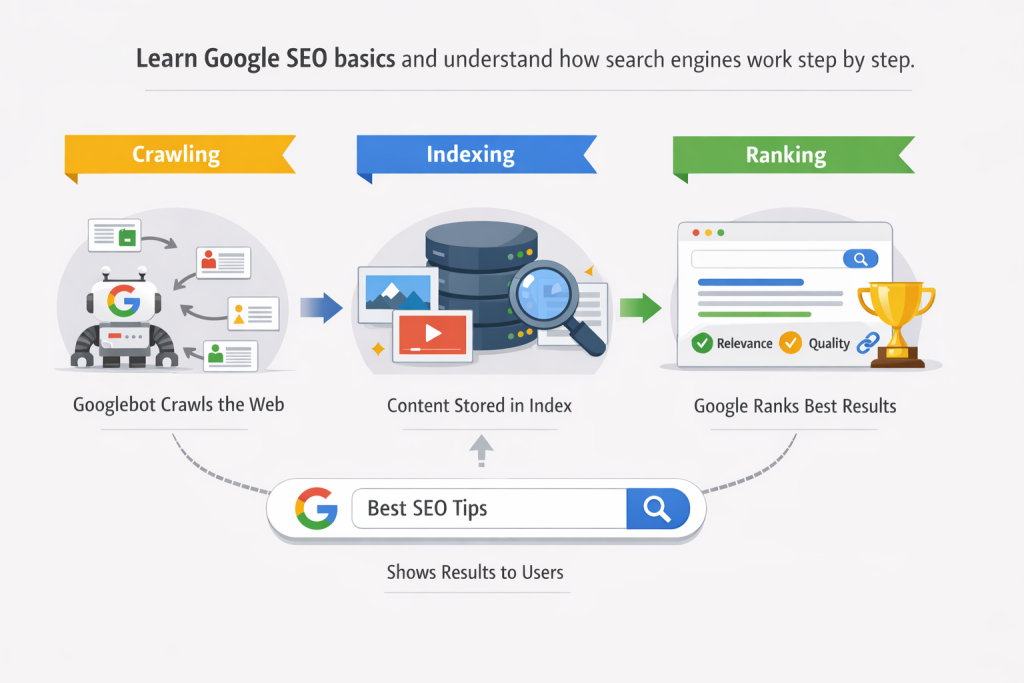
To understand SEO, you first need to understand the search engine itself. Google is a fully automated search engine that constantly crawls the web using software called crawlers or Googlebot. You can think of Google’s process in three main stages:
- Crawling – Discovering Your Pages
- Indexing – Understanding and Storing Your Content
- Ranking – Serving the Best Results to Users
These steps form the foundation of all Google SEO basics.
Stage 1: Crawling – Discovering Your Page
Crawling is the first step. Google sends out bots (spiders) to discover new and updated web pages. These crawlers start with a list of known web addresses from previous crawls. As they visit each page, they follow the links on that page to discover new URLs. Imagine a spider moving across its web – that’s how Googlebot explores the internet.
Tips to Improve Crawling:
- Submit your XML sitemap via Google Search Console.
- Use internal linking so Google can easily find all your pages.
- Avoid broken links or orphaned pages.
- Keep your website structure simple and logical.
Pro Tip: Even if your site is new, submitting a sitemap and ensuring internal links exist can dramatically speed up indexing.
Explore additional insights at the Search Engine Journal SEO Guide.
Stage 2: Indexing – Understanding and Storing Your Content
Once a page is crawled, Google tries to understand what it’s about. This process is called indexing. During indexing, Google analyzes:
- Text content and headings
- Images, alt texts, and videos
- Meta descriptions and titles
- Page structure
All of this is stored in Google’s massive index — a digital library of billions of web pages. Without proper indexing, even the best content cannot appear in search results.
How to Help Google Index Your Site:
- Use descriptive titles and headings (H1, H2, H3).
- Ensure all important pages are linked internally.
- Avoid duplicate content, which can confuse Google.
- Optimize images with alt text

Stage 3: Ranking – Answering User Queries
This is where Google decides which page appears first. Google’s algorithms evaluate hundreds of factors to determine relevancy and quality. Key factors include:
- Query relevance: Does your page match what the user wants?
- Content quality: Is your page helpful, unique, and reliable?
- User experience: Is the page mobile-friendly and fast-loading?
- Authority: Do other reputable websites link to your page?
- Context: Location, language, and user behavior.
Google’s goal is simple: show the best possible answer in a fraction of a second. Mastering Google SEO basics increases the chances your content becomes that answer.
Practical SEO Tips to Boost Visibility
1. Make Sure Google Can Find Your Content
Check if your site is indexed:site:yourwebsite.com
If no results appear, submit your sitemap in Google Search Console and review your robots.txt file to ensure Google isn’t blocked.
2. Choose a Focus Keyword
Your focus keyword is the main phrase you want a page to rank for. For example:
- This article: Google SEO Basics
- Chocolate cake recipe: Easy Chocolate Cake Recipe
Use it naturally in:
- Title
- Headings
- First paragraph
- Meta description
- Image alt text
Pro Tip: Avoid keyword stuffing — Google favors natural, readable content.
3. Organize Your Site & Content
- Use descriptive URLs:
example.com/google-seo-basics - Structure headings: H1 for main title, H2 for sections, H3 for sub-sections
- Create an easy-to-navigate menu: Helps users and Google
4. Optimize On-Page SEO
On-page SEO is about making your page understandable for both users and search engines.
Key Elements:
- Title Tag: Under 60 characters with focus keyword
- Meta Description: Under 155 characters, compelling, with focus keyword
- Headings: H1, H2, H3 properly structured
- Images: Alt text with focus keyword if relevant
5. Build Trust & Authority
Internal Links: Connect your pages so Google can discover more content.
External Links / Backlinks: Links from reputable websites signal quality to Google.
Example: Linking to official guides like Google Developers or Moz Beginner SEO Guide
6. Focus on User Experience (UX)
- Fast page load speed
- Mobile-friendly design
- Easy navigation
- Readable fonts and layout
Google ranks sites higher that provide excellent UX.

7. Track Your Progress
Use tools like:
- Google Search Console: Track indexing, keywords, technical errors
- Google Analytics: See traffic, popular pages, and visitor behavior
Advanced Google SEO Basics Concepts
Understanding Google Algorithms
Google algorithms rank pages based on:
- Relevance
- Quality
- Authority
- User signals
Staying updated with algorithm changes is crucial for SEO success.
Backlinks
Backlinks act as “votes of confidence.” High-quality backlinks improve authority and ranking. Earn them through:
- Guest posts
- High-quality original content
- Resource pages
Mobile Optimization
Over 60% of searches are mobile. A mobile-friendly design improves ranking and user engagement.
Page Speed Optimization
- Compress images
- Minify CSS/JS
- Use caching plugins
Faster websites improve user experience and ranking.
Content Depth & Originality
Google favors in-depth, original content. Aim for 1,500–3,000 words per pillar post with subtopics, FAQs, examples, and internal links.
SEO Tools for Google SEO Basics
- Google Search Console: Indexing & performance
- Google Analytics: Traffic insights
- Rank Math / Yoast SEO: On-page optimization
- Ahrefs / SEMrush: Competitor and keyword research
How Long Does SEO Take?
SEO is a long-term strategy:
- 1–3 months → Small improvements
- 3–6 months → Noticeable traffic
- 6+ months → Strong ranking
Consistency and patience are key.
👉 Understand why SEO is important for websites:
https://bigyankhadkacom.com/why-seo-is-important-for-websites/
Conclusion: Google SEO Basics for Long-Term Success
Google SEO basics may seem overwhelming at first, but everything comes down to one simple idea: create high-quality content for real people and make it easy for search engines to understand your content through proper SEO structure and keyword usage.
To build long-term success, focus on the core elements of SEO:
- Crawling, indexing, and ranking
- High-quality, valuable content
- Smart use of focus keywords
- User experience (UX) and mobile optimization
- Strong internal and external linking
- Building authority through natural backlinks
When you apply these Google SEO basics consistently, you not only improve your rankings but also enhance user behavior signals like engagement, dwell time, and trust. This leads to higher CTR (click-through rate) and better visibility in search results.
Start small. Apply one or two strategies today. Focus on improving content quality, targeting the right keywords, and creating helpful content that people actually want to read and share.
Over time, your efforts will compound. Better content leads to better rankings, more traffic, stronger backlinks, and long-term SEO growth.
By mastering Google SEO basics, you build a solid foundation that helps your website grow steadily and succeed in the long run 🚀
Pingback: 7 Smart Ways to Find Low Competition Keywords (Rank Fast Guide for Beginners)
Pingback: 7 Powerful Long-Tail Keywords for Beginners to Get Traffic Fast
Pingback: Why SEO is Important for Websites (Beginner Guide)
Pingback: On-Page SEO for Beginners: How to Rank Higher on Google
Pingback: SEO Without Paid Tools (7 Proven Free Methods That Actually Work)