
If you have a website or a blog, you’ve probably heard about types of SEO for beginners many times. SEO (Search Engine Optimization) is the process of helping search engines like Google understand your content so it can be shown to the right audience at the right time.
Think of your website as a book. SEO helps Google place your book on the right shelf, making it easier for readers to discover it. When your content is properly optimized with the right keywords, better content quality, and clear structure, it improves your chances of ranking higher in search results.
For beginners, SEO may feel overwhelming at first. But when you break it down into simple parts, it becomes much easier to understand and apply. Learning the different types of SEO is the first step toward improving your website’s performance, increasing your click-through rate (CTR), and enhancing user behavior signals like engagement and time on site.
👉 New to SEO? Start with this simple beginner guide:
https://bigyankhadkacom.com/seo-for-beginners/
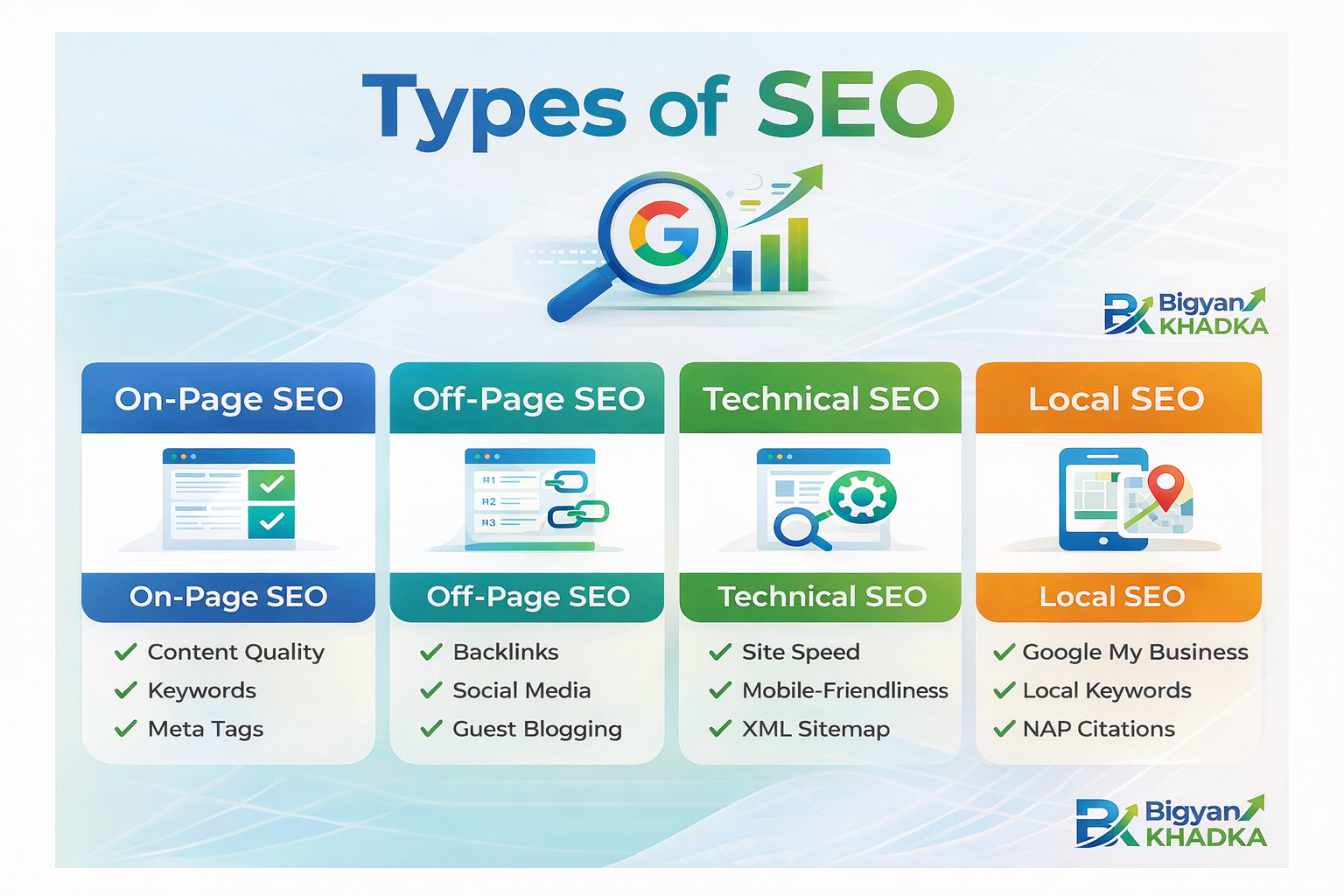
Most SEO strategies are divided into three main types: On-Page SEO, Off-Page SEO, and Technical SEO, with an additional focus on Local SEO for location-based businesses. Each type plays a crucial role in improving your rankings, building authority through backlinks, and creating a better experience for your users.
By understanding these types of SEO for beginners, you can build a strong foundation, create high-quality content, and grow your website traffic consistently over time.
Types of SEO Explained
What Are the Core Types of SEO?
The main types of SEO that beginners should focus on are:
- On-Page SEO – Optimizing your website’s content to make it valuable for readers and search engines.
- Off-Page SEO – Building your website’s authority through backlinks and mentions on other websites.
- Technical SEO – Improving the website’s structure, speed, and crawlability for search engines.
- Local SEO – Ensuring your business is discoverable in local searches and maps.
Let’s break down each type in detail.
Explore additional insights at the Search Engine Journal SEO Guide.
1. On-Page SEO: Optimizing Your Website Content
On-Page SEO is the easiest type for beginners to start with because you have full control. It involves optimizing content, headings, images, and internal links so both users and search engines can understand your website.
Key Elements of On-Page SEO
Keyword Research and Optimization
Before creating content, research the terms your audience is searching for. For example, if you are writing about cookies, your keywords might be “best chocolate chip cookie recipe” or “easy cookie baking tips.” Include your focus keyword Types of SEO Explained for Beginners naturally in:
- Title (H1)
- Subheadings (H2, H3)
- First 100 words
- Image alt text
Do not stuff keywords. Natural usage is important.
Title Tags and Meta Descriptions
The title tag is the clickable headline in search results. The meta description is the short snippet below it. Both should include your focus keyword to improve click-through rate.
Header Tags (H1, H2, H3)
Use headings to structure your content. H1 for the main title, H2 for main sections, and H3 for sub-sections. Proper headings help Google understand your content.
Internal Linking
Link to other pages on your website. This improves navigation and helps Google index more of your site.
2. Off-Page SEO: Building Authority and Trust
Off-Page SEO is everything that happens outside your website that affects your ranking. This mainly involves backlinks, social media, and online mentions.
👉 Learn keyword research for beginners step by step here:
https://bigyankhadkacom.com/keyword-research-for-beginners/
Backlinks
Backlinks are links from other reputable websites to your content. Google sees these as votes of confidence. One high-quality backlink from a trusted site is more valuable than dozens from low-quality sites.For example, you can learn more about SEO best practices from the Google SEO Starter Guide and improve your strategy by following insights from Moz Beginner’s Guide to SEO and Ahrefs SEO Guide. These trusted resources help beginners understand how search engines evaluate websites.
3. Technical SEO: The Foundation of Your Website
Technical SEO ensures that search engines can crawl, index, and understand your website. Without technical SEO, even the best content may not rank.
Important Technical SEO Factors
Site Speed
A fast website improves user experience and rankings. Compress images, use caching, and choose a good hosting provider.
Mobile-Friendliness
Most users browse from mobile devices. A responsive website improves usability and SEO.
Crawlability and Indexing
Submit an XML sitemap to Google Search Console. Make sure robots.txt doesn’t block important pages.
Security (HTTPS)
Secure websites rank better. Install an SSL certificate so your site uses HTTPS.

4. Local SEO: Getting Discovered Near You
Local SEO is crucial for businesses with physical locations. It helps customers find you on Google Maps and local search results.
Google Business Profile
Create or claim your profile. Ensure Name, Address, and Phone number (NAP) are correct. Encourage reviews from happy customers.
Explore additional insights at the Search Engine Journal SEO Guide.
Local Citations
List your business in online directories like Yelp and Yellow Pages. Consistent NAP info across platforms builds trust.
Local Reviews
Positive reviews improve local rankings and credibility.
Combining All SEO Types
To rank your website effectively:
- Focus on On-Page SEO – create helpful content with focus keywords.
- Start with Technical SEO – make your site fast, mobile-friendly, and secure.
- Build Off-Page SEO – earn backlinks and mentions.
- If relevant, use Local SEO to capture nearby customers.
Think of it as a pyramid: Technical SEO forms the foundation, On-Page builds the structure, Off-Page adds credibility, and Local SEO targets your audience nearby.
Final Tips for Beginners
To succeed with types of SEO for beginners, always focus on creating value for your users first. Search engines prioritize content that delivers a great experience and solves real problems.
👉 Understand why SEO is important for websites and how it helps you grow:
https://bigyankhadkacom.com/why-seo-is-important-for-websites/
- ✔ Focus on user experience (UX) to improve engagement, dwell time, and overall user behavior signals
- ✔ Use variations of your focus keyword naturally to avoid keyword stuffing and improve SEO relevance
- ✔ Regularly update old content to maintain content quality and keep your rankings strong
- ✔ Track your performance using tools like Google Analytics and Search Console to understand traffic, CTR, and user behavior
- ✔ Build authority by earning backlinks from trusted websites and creating high-quality, shareable content
By applying these strategies from this guide on types of SEO for beginners, you can improve your search rankings, increase your click-through rate (CTR), and attract consistent organic traffic.
SEO is not a one-time task—it’s a long-term strategy. Stay consistent, focus on quality, and keep optimizing based on data.
Over time, your website will grow, rank higher, and build strong online authority.
Happy optimizing! 🚀
Pingback: 9 Proven Keyword Research for Beginners Steps (Simple & Powerful Guide)
Pingback: Why SEO is important for websites