Introduction: The Day I Stopped Chasing Google’s Algorithm
I used to wake up in cold sweat every time Google announced an update.
“Did my traffic just drop?”
“Is my site penalized?”
“What did I do wrong?”
I remember scrolling through SEO Twitter, reading all the panic about the latest core updates. Everyone was worried. And honestly? I was worried too.
Because I didn’t really understand how Google worked. I was just guessing. I was following random advice from so-called experts and chasing quick tactics instead of learning the fundamentals.
Then one day, after losing nearly 30% of my traffic overnight (later I realized it was just a technical issue, not an update), I decided something had to change.
I stopped guessing. I started learning.
I tested things on my own site, studied what actually worked, and tracked results over time.
That’s when everything became clear.
Google’s ranking system isn’t as complicated as it seems. At its core, it really comes down to a few important signals — what I now call the core SEO ranking factors.
These factors decide whether your content ranks, gets ignored, or disappears completely from search results.
If you’re struggling to keep visitors on your site, my here: https://bigyankhadkacom.com/internal-linking-strategy-for-beginners/will help you improve engagement and structure.
In this guide, I’ll walk you through each of these factors — what they are, why they matter, and how I personally used them to grow my traffic from almost zero to consistent results.
No theory. No fluff. Just practical strategies that actually work.
What Are Core SEO Ranking Factors? (The Simple Truth)
Let me clear something up right away.
When I first started, I thought there were hundreds of ranking factors. Some SEO blogs even claim there are 200+. And technically, Google does consider many different signals.
But here’s what I learned after years of testing: only a handful of factors truly make a difference, especially for beginners trying to rank their content.
The rest are either:
- Minor signals that only matter at large scale, or
- Things you can’t control, like domain age or authority history
The five factors I’m about to share are the ones that actually moved the needle for me. Whenever I improved these areas, my rankings improved too — consistently.
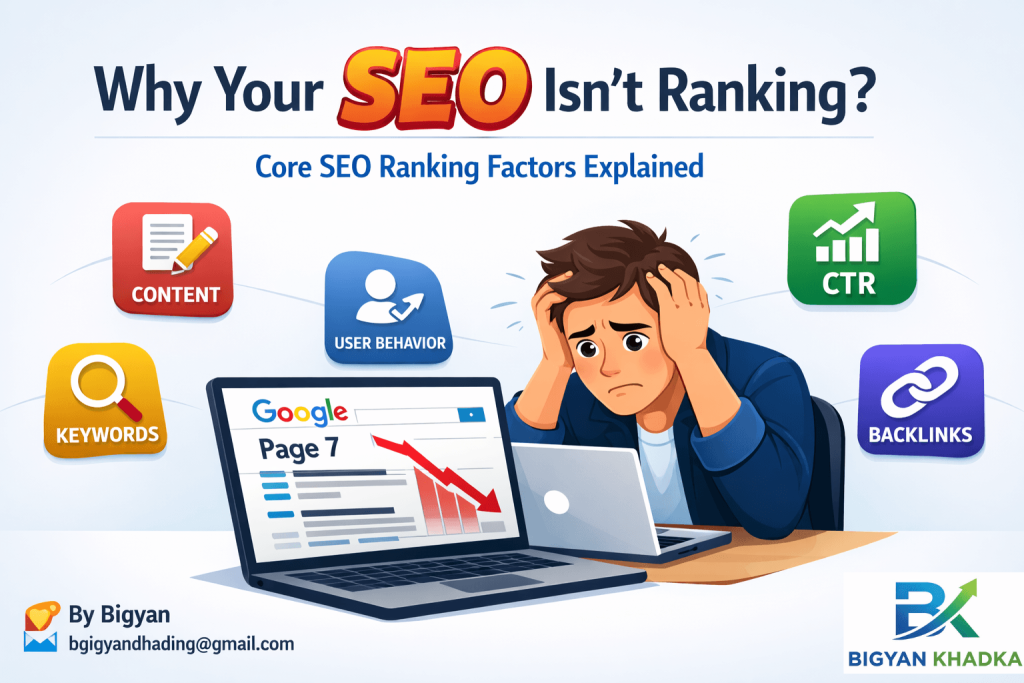
These are what I now call the core SEO ranking factors, and they include:
- Keywords – helping Google understand what your page is about
- Quality Content – delivering real value to the reader
- Click-Through Rate (CTR) – getting people to click your result
- User Behavior – how users interact with your page
- Backlinks – signals of trust from other websites
These core SEO ranking factors don’t work in isolation. You can’t ignore one and expect the others to carry your results.
Trust me — I’ve tried that approach before, and it doesn’t work.
After testing multiple blog posts, I noticed something interesting: whenever I improved one of these core SEO ranking factors, my rankings and traffic improved as well.
And yes, while some of these factors are often labeled as “on-page” or “off-page,” in reality, these core SEO ranking factors work together as a system.
Why These 5 Factors Matter (Even for Beginners)
Let me share a quick story that completely changed how I approach SEO.
I had two blog posts on similar topics. They were almost identical in terms of keyword difficulty, length, and internal linking.
But the results were very different:
- Post A ranked #2
- Post B ranked #14
I couldn’t understand why at first, so I analyzed both pages closely.
Here’s what I found:
Post A had:
- A more compelling title (higher CTR)
- Lower bounce rate (people stayed longer)
- 3 quality backlinks from small blogs
Post B had:
- A boring, generic title
- 70% bounce rate (people left quickly)
- Zero backlinks
Even though both posts targeted the same keywords and had similar content, the difference came down to these core SEO ranking factors.
That’s when I stopped treating SEO as a simple checklist and started treating it as a system.
These core SEO ranking factors are not separate — they are connected.
- Better keywords bring the right audience
- Quality content keeps them engaged
- Strong CTR gets them to click
- Good user behavior shows Google your content is valuable
- Backlinks build trust and authority
When all of these core SEO ranking factors work together, that’s when real traffic growth begins.
Factor 1: Keywords – The Foundation of Relevance
Let me start with the one everyone talks about.
Keywords are how you tell Google and readers what your page is about.
But here’s where I messed up early on. I thought keywords meant stuffing my target phrase into every sentence. I had blog posts that said “best coffee maker” 47 times. It was painful to read. And guess what? Google didn’t reward me. Readers left immediately.
What I Learned About Keywords (The Hard Way)
1. Search intent is everything
I once wrote a post targeting “how to bake a cake” but I focused on the history of cake baking. Nobody cared. People wanted step-by-step instructions. I wasn’t matching their intent. The post flopped.
Now, before I write anything, I ask: “What is the person searching for this actually trying to DO?”
- Are they looking to buy? (commercial intent)
- Are they trying to learn? (informational intent)
- Are they comparing products? (comparison intent)
Match the intent, or you won’t rank. Simple as that.
2. Long-tail keywords are beginner gold
When I started, I targeted “SEO tips.” Impossible. Big sites owned that.
Then I switched to “SEO tips for small bakeries” (my niche at the time). Suddenly I was ranking. The traffic was smaller, but it was MY traffic.
Long-tail keywords (3-5 word phrases) have lower competition and higher conversion rates. Don’t ignore them.
3. Use keywords naturally (not like a robot)
My rule now: Write for humans first. Then go back and make sure your primary keyword appears in:
- Title tag
- First 100 words
- One H2 heading
- A few times naturally throughout (not forced)
That’s it. You don’t need 5% keyword density. You need relevance and readability
If you’re struggling to find the right keywords, check out my here:https://bigyankhadkacom.com/keyword-research-for-beginners/
Factor 2: Quality Content – The Reason People Stay
I used to think “quality content” meant long content. 3000 words or bust.
Then I wrote a 5000-word guide that nobody finished. Average time on page: 90 seconds. Ouch.
Quality isn’t length. Quality is usefulness.
What Quality Content Actually Looks Like
It answers the question completely
If someone searches “how to fix a leaky faucet,” your post should tell them exactly how. Tools needed. Step-by-step photos. What to do if it doesn’t work.
Don’t make them search elsewhere. Be the final answer.
It’s easy to read and scan
I learned this from my own reading habits. I never read blog posts word-for-word. I scan. I look for bold text, bullet points, and headings that answer my question.
Now I write the same way I read. Short paragraphs. Clear headings. Plenty of white space.
It’s honest and experience-based
This was a game-changer for me.
Early on, I wrote generic advice that I’d read on other blogs. It was accurate, but it was boring. Nobody trusted it because I sounded like everyone else.
When I started sharing my real failures and successes – “I tried this and it failed,” “Here’s what actually happened when I tested X” – suddenly people stayed longer. They commented. They shared.
Google notices when people actually read your content instead of bouncing.
It’s updated regularly
I had a post from 2021 that was ranking well. By 2024, the information was outdated. Traffic dropped.
Now I go through my top 20 posts every 3-6 months and refresh them. New data. Updated examples. Fixed broken links.
Each time I refresh, rankings bump up within 2-3 weeks.
Factor 3: CTR – Getting the Click You Deserve
This factor surprised me the most.
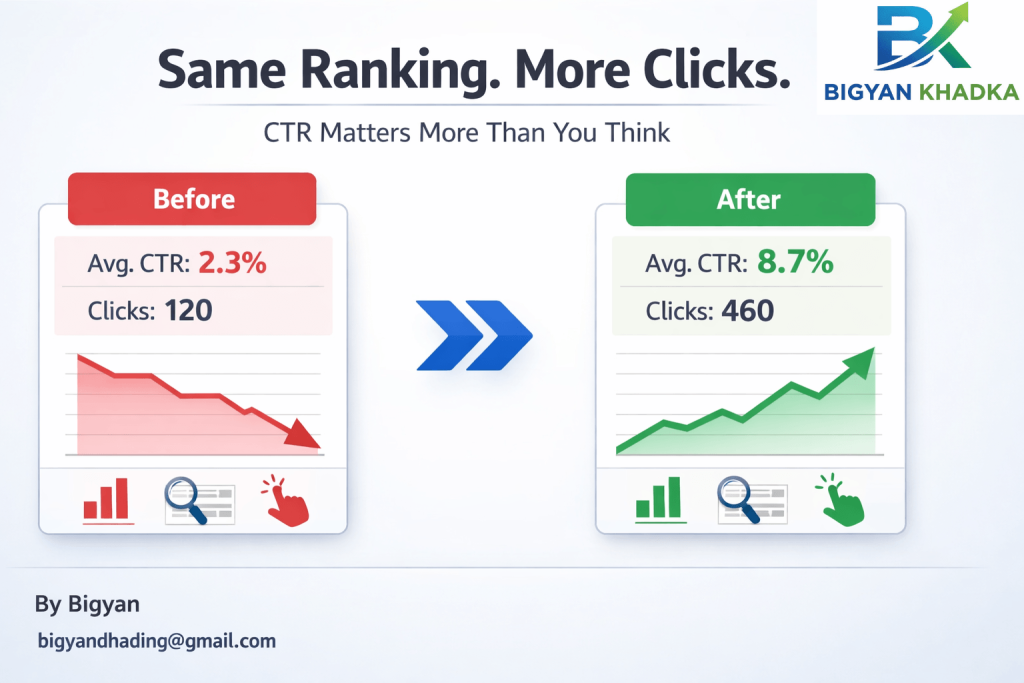
You can have the best content in the world. If your title and meta description are boring, nobody clicks. And Google sees low click-through rate as a signal that your result isn’t what people want.
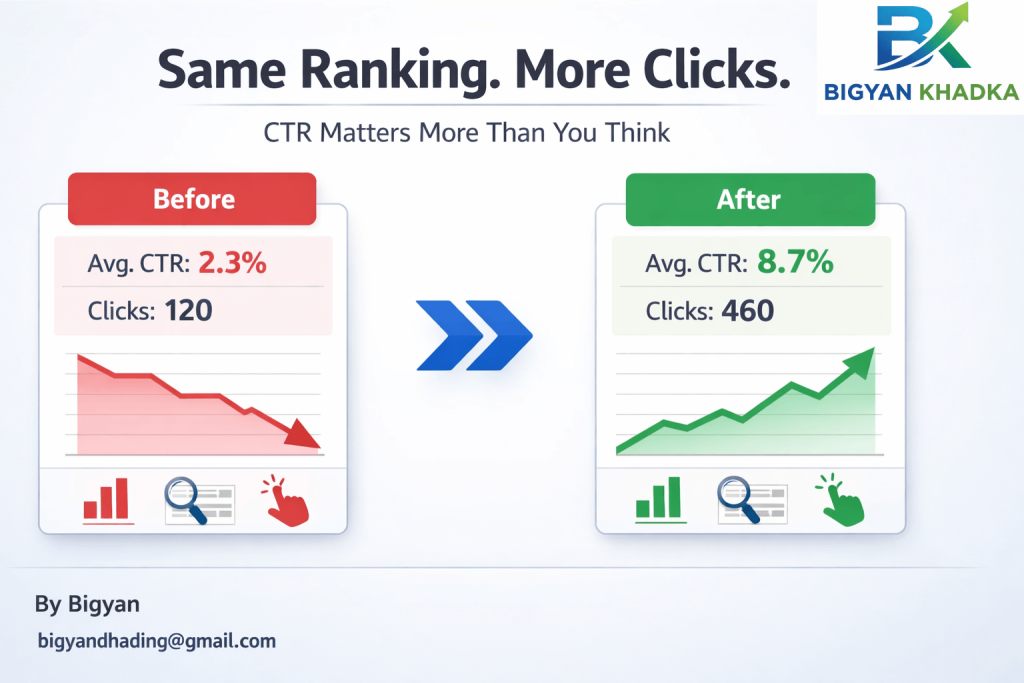
How I Doubled My CTR (Without Changing Rankings)
The title tag formula that works for me:
[Number] [Adjective] [Keyword] + [Benefit or Year]
Examples:
- “7 Easy Ways to Improve Your CTR (2025 Update)”
- “The Beginner’s Guide to Core SEO Ranking Factors”
- “Why I Stopped Ignoring User Behavior (And You Should Too)”
What I avoid:
- Clickbait that doesn’t deliver
- All caps or excessive punctuation
- Keyword stuffing (looks spammy)
The meta description hack that changed everything
Your meta description isn’t a direct ranking factor. But it heavily influences CTR.
I used to write boring descriptions like: “This post covers core SEO ranking factors including keywords, content, and backlinks.”
Now I write: “Struggling to rank? After testing 50+ posts, here are the 5 SEO factors that actually moved the needle for me. Plus common mistakes to avoid.”
See the difference? The second one promises a specific benefit and creates curiosity.
How to test CTR improvements
Go to Google Search Console > Performance. Look at your pages with the most impressions but lowest CTR (under 3-5%).
Rewrite those titles and descriptions. Wait 2-4 weeks. Compare CTR before and after.
I did this for 12 pages and saw CTR increase by an average of 67%. Zero new content. Zero new backlinks. Just better packaging.
Factor 4: User Behavior – What People Do After They Click
This is the factor that separates amateurs from people who actually understand SEO.
Google watches how users interact with your site.
Not directly – they can’t see your screen. But they can see:
- Dwell time – how long between clicking your result and returning to Google
- Bounce rate – did they leave without interacting?
- Pogo-sticking – did they click your result, then immediately go back and click another result?
- Pages per session – did they click through to other pages on your site?
If people click your result and immediately bounce back to Google, Google thinks: “This result wasn’t helpful. Let’s demote it.”
If people stay on your site for 5 minutes, scroll to the bottom, and click internal links, Google thinks: “This result is great. Let’s promote it.”
How I Improved User Behavior Signals
I made my content scannable
Before: giant walls of text. After: short paragraphs, bullet points, bold key phrases, images every 300-500 words.
Bounce rate dropped from 72% to 54% on my top 10 posts.
I added a table of contents at the top
This was surprisingly effective. People could jump to exactly what they needed. Dwell time increased by 35% on posts with a TOC.
I used internal links strategically
At the end of each post, I added a “What to read next” section with 3 relevant posts. Pages per session doubled within a month.
I improved page speed
Slow sites frustrate users. I switched to faster hosting, compressed images, and used a caching plugin. Load time went from 4.2 seconds to 1.8 seconds. Bounce rate improved by 18%.
The takeaway: Make it easy for people to consume your content and explore your site. Google will notice.
Factor 5: Backlinks – The Trust Signal That Never Goes Away
I saved this for last because beginners obsess over it too much – but also shouldn’t ignore it completely.
Backlinks are votes of confidence from other websites.
When a reputable site links to you, Google thinks: “If they trust this content, maybe we should too.”
But here’s what I learned after wasting months on bad backlinks.
To understand backlinks in detail, read my here:https://bigyankhadkacom.com/off-page-seo-for-beginners/
Quality Over Quantity (Always)
I once bought 50 backlinks for $20. My rankings dropped. My site looked spammy. I spent weeks disavowing those links.
One relevant, high-quality backlink is worth more than 100 spammy ones.
Backlink Strategies That Actually Worked For Me
1. Guest posting on real blogs
Not “write for us” pages. Real blogs with engaged readers. I offered genuine value and got dofollow links in return.
2. Broken link building
Find a broken link on a relevant site. Email the owner: “Hey, this link is broken. I have a similar resource – here it is.” Got 3 backlinks this way in one afternoon.
3. Creating linkable assets
I created a free SEO checklist (20 pages). People linked to it naturally because it was genuinely useful.
4. Skyscraper technique
Find popular content in your niche. Make something significantly better. Reach out to people who linked to the original and show them your improved version.
What I stopped doing:
- Buying backlinks
- Comment spam
- Forum links with exact match anchor text
- Link exchanges (“you link to me, I’ll link to you”)
How many backlinks do you need?
For beginners? Start with 10-20 quality backlinks to your best posts. That’s enough to see movement. Then build consistently – 2-5 new backlinks per month.
I got my first 15 backlinks through guest posts and broken link building. Within 3 months, my domain authority went from 8 to 19. Traffic grew by 45%.
How These 5 Factors Work Together (The Magic Is in the Mix)
Here’s something I wish someone had told me when I first started.
You can’t focus on just one thing and expect results.
I tried ranking with only keywords and content. It didn’t work.
I tried relying only on backlinks. Still didn’t work.
I even focused only on improving CTR — I got clicks, but people didn’t stay because the content wasn’t strong enough.
That’s when I realized the truth.
The real power of SEO comes when all the core SEO ranking factors work together.
🔗 How These Core SEO Ranking Factors Connect
- Good keywords → attract the right audience
- Strong CTR → people actually click your result
- Quality content → keeps them reading
- Positive user behavior → signals Google that your page is valuable
- Backlinks → build trust and authority
Each of these core SEO ranking factors supports the others. When one improves, it strengthens the entire system.
⚠️ Why Balance Matters
- A page with backlinks but poor content won’t perform well (users will leave quickly).
- Great content without backlinks may take longer to rank.
- High CTR without valuable content can increase bounce rate and hurt rankings.
To get consistent growth, you need to optimize all core SEO ranking factors together.
📚 Learn More
For deeper understanding, you can explore:
- Google’s official SEO Starter Guide
- Moz Beginner SEO Guide
These resources explain many of the same principles and help reinforce these core SEO ranking factors in practice.
Common Mistakes I Made With These 5 Factors
Let me save you some pain.
Mistake 1: Keyword Stuffing
I thought more keywords = better rankings. My content was unreadable. Google penalized me. Readers hated it.
Fix: Write naturally. Use synonyms. Focus on topics, not just exact-match phrases.
Mistake 2: Writing for Google, Not Humans
I wrote “SEO-optimized” content that was dry and boring. Dwell time was terrible. Rankings were mediocre.
Fix: Write for a specific person. Use “you” and “I.” Tell stories. Be helpful.
Mistake 3: Ignoring CTR Because “Rankings Are All That Matters”
I was #2 for a keyword but getting fewer clicks than the #5 result. Why? Their title was way better.
Fix: Spend as much time on your title and description as you do on your content.
Mistake 4: Obsessing Over Bounce Rate Without Context
A recipe blog post has high bounce rate (people get the recipe and leave). That’s fine. A tutorial post with high bounce rate? Problem.
Fix: Understand normal bounce rate for your content type before panicking.
Mistake 5: Building Any Backlink I Could Get
I said yes to every link opportunity. Directory sites. Random forums. Even a gambling site (my niche was healthy eating – made zero sense).
Fix: Be picky. One relevant backlink from a real blog is worth 100 spammy ones.
How Long It Takes to See Results (Realistic Timeline)
Let me be honest with you.
Week 1-2: Keyword and content improvements might show small ranking bumps for low-competition terms.
Week 3-4: CTR changes can show impact within days if you’re already ranking.
Month 2: User behavior improvements (better bounce rate, dwell time) start showing in analytics. Rankings may move slowly.
Month 3: Backlinks you built in month 1 start getting crawled. This is often when you see a noticeable jump.
Month 4-6: All five factors working together. Traffic growth becomes consistent – often 30-60% over starting point.
Month 6-12: Compounding. Each new piece of content benefits from the authority you’ve built. Growth accelerates.
I didn’t see real results until month 4. But by month 8, my traffic had tripled. Patience and consistency win.
Final Thoughts: Your 5-Step Action Plan
You don’t need to master everything at once.
Trying to fix all the SEO ranking factors in a single day will only overwhelm you. Instead, start small. Focus on what’s easiest, build momentum, and then gradually improve the rest.
Here’s a simple action plan you can follow this week:
Step 1: Audit Your Keywords
Start by reviewing your 5 most important posts.
- Is the search intent clear?
- Are you targeting the right long-tail keywords?
- Does the content match what users are actually searching for?
If not, update your keywords and align them with user intent.
Step 2: Improve Your CTR
Go to Google Search Console and find pages with low click-through rates (under 3%).
- Rewrite your titles to be more engaging
- Improve your meta descriptions to create curiosity
- Make people want to click your result
Even small improvements here can make a big difference.
Step 3: Fix One User Behavior Issue
Choose your highest-traffic post and improve the user experience.
- Break long paragraphs into smaller ones
- Add images or visuals
- Include a table of contents
Then monitor your bounce rate over the next 1–2 weeks.
Step 4: Create One Linkable Asset
Create something valuable that others will naturally want to link to:
- A checklist
- A template
- A case study
Publish it, then reach out to a few relevant websites and ask for a backlink.
Step 5: Write One High-Quality Piece of Content
Before publishing, ask yourself:
- Does this fully answer the user’s question?
- Is it easy to read and understand?
- Does it provide real value and experience?
Focus on creating content that truly helps your audience.
If you follow these five steps, you’ve already improved all the core SEO ranking factors that matter most.
And then repeat the process next week.
🚀 Final Message
This isn’t complicated.
SEO isn’t about tricks or hacks — it’s about consistency and understanding what works.
I went from panicking every time Google released an update to barely worrying about them.
Why?
Because I focused on the fundamentals — the core SEO ranking factors that actually drive results.
Algorithms may change, but Google’s goal never does:
👉 Deliver helpful, relevant, and trustworthy content that people engage with.
If you stay focused on that, you’re already ahead of most beginners.
Frequently Asked Questions (FAQs)
Still have questions? Here are some quick answers:
Q1: What are core SEO ranking factors?
Core SEO ranking factors are the main elements that influence how your content ranks on Google. These include keywords, content quality, click-through rate (CTR), user behavior, and backlinks. When optimized together, they significantly improve your chances of ranking higher.
Q2: Which SEO factor is most important?
There is no single most important factor. However, for beginners, content quality and user behavior usually have the biggest impact. If your content is helpful and users stay longer, Google is more likely to rank it higher.
Q3: How long does SEO take to show results?
SEO typically takes 3 to 6 months to show noticeable results. This depends on factors like competition, content quality, consistency, and backlinks.
Q4: Do backlinks still matter in SEO?
Yes, backlinks are still a major ranking factor. High-quality backlinks from trusted and relevant websites help build your authority and improve your search rankings.
Q5: Can I rank without backlinks?
Yes, you can rank without backlinks for low-competition keywords. However, for competitive topics, backlinks are usually necessary to achieve higher rankings.Frequently Asked Questions (FAQs)
Still have questions? Here are some quick answers:
Q4: Do backlinks still matter in SEO?
Yes, backlinks are still a major ranking factor. High-quality backlinks from trusted and relevant websites help build your authority and improve your search rankings.
Q5: Can I rank without backlinks?
Yes, you can rank without backlinks for low-competition keywords. However, for competitive topics, backlinks are usually necessary to achieve higher rankings.
For more insights, check out :Google’s SEO Starter Guide.