
How I Finally Started Growing My Rankings with Backlinks, CTR, Brand Signals & User Behavior
By Bigyan Khadka · Updated May 2026 · Beginner Friendly Guide
Quick Summary
If you only remember five things from this guide, remember these:
- Quality backlinks matter more than backlink quantity
- Google watches CTR and user behavior closely
- Brand mentions are becoming more powerful every year
- Community participation builds real authority naturally
- Off-page SEO takes time, but the results compound long-term
The Moment I Realized My SEO Was Broken
Off-page SEO for beginners is one of the most important parts of modern SEO, yet most new bloggers completely ignore it. When I first started blogging, I focused only on on-page SEO and forgot that Google also measures trust, authority, backlinks, CTR, and brand signals outside my website.
I still remember the frustration clearly.
For months, I worked hard on my blog every single day. I optimized my titles, improved my images, fixed my URLs, wrote long articles, learned keyword research, and followed almost every on-page SEO tutorial I could find.
But nothing happened.
My traffic barely moved.
Some posts stayed invisible for weeks. Others reached page three or four of Google and never moved higher. It felt exhausting because I knew I was putting in real effort.
Then one evening, I checked a competitor’s website.
Honestly, their content was not even better than mine.
But they ranked above me for almost every keyword I wanted.
So I started researching deeper.
That was when I discovered something that completely changed how I understood SEO:
They had authority.
Hundreds of backlinks.
Brand mentions.
Community engagement.
People actually talking about their website online.
That was my first real lesson about off-page SEO.
I realized something important that most beginners do not understand early enough:
On-page SEO helps Google understand your content.
Off-page SEO helps Google trust your content.
And trust changes rankings.
Once I started focusing on backlinks, CTR, user behavior, community participation, and brand signals, my rankings slowly started improving in ways that title optimization alone never achieved.
This guide is everything I wish someone had explained to me when I first started blogging.
No spam.
No fake SEO tricks.
No dangerous shortcuts.
Just real beginner-friendly strategies that actually work in 2026.
9 Proven Keyword Research Steps for Beginners
What Is Off-Page SEO for Beginners?
Off-page SEO for beginners refers to everything you do outside your own website to improve rankings, authority, and trust in search engines.
Unlike on-page SEO, which focuses on optimizing content inside your website, off-page SEO focuses on external signals such as backlinks, brand mentions, social visibility, and user engagement.
Google uses these signals to understand whether your content is trustworthy and valuable enough to rank higher in search results.
Some of the most important off-page SEO factors include:
- High-quality backlinks
- Brand mentions
- Click-through rate (CTR)
- User behavior signals
- Guest posting
- Community engagement
- Online reputation
Why Off-Page SEO for Beginners Matters in 2026
In 2026, Google’s algorithms are smarter than ever. Search engines no longer rely only on keywords and backlinks. They also evaluate trust, authority, experience, and user satisfaction.
That means off-page SEO for beginners is now more important than ever before.
Even if your article is well-written, it may struggle to rank if your website lacks authority and reputation signals.
Modern SEO success depends heavily on:
- trust,
- engagement,
- brand recognition,
- and real user interaction.
This is why bloggers who build authority outside their websites usually rank faster and more consistently.
Best Backlink Strategies in Off-Page SEO for Beginners
Backlinks remain one of the strongest ranking signals in Google.
However, beginners often make the mistake of focusing on quantity instead of quality.
One high-quality backlink from a trusted website can be more powerful than dozens of weak backlinks from random sites.
Here are some of the safest backlink strategies for beginners:
Create Linkable Content
Publish detailed guides, original experiences, infographics, and useful tutorials people naturally want to reference.
Guest Posting
Write valuable articles for trusted blogs in your niche and build relationships with real audiences.
Broken Link Building
Find broken links on websites and suggest your helpful content as a replacement.
Community Participation
Helpful participation on Reddit, Quora, LinkedIn, and Facebook groups can naturally attract backlinks and visibility over time.
How CTR Helps Off-Page SEO for Beginners
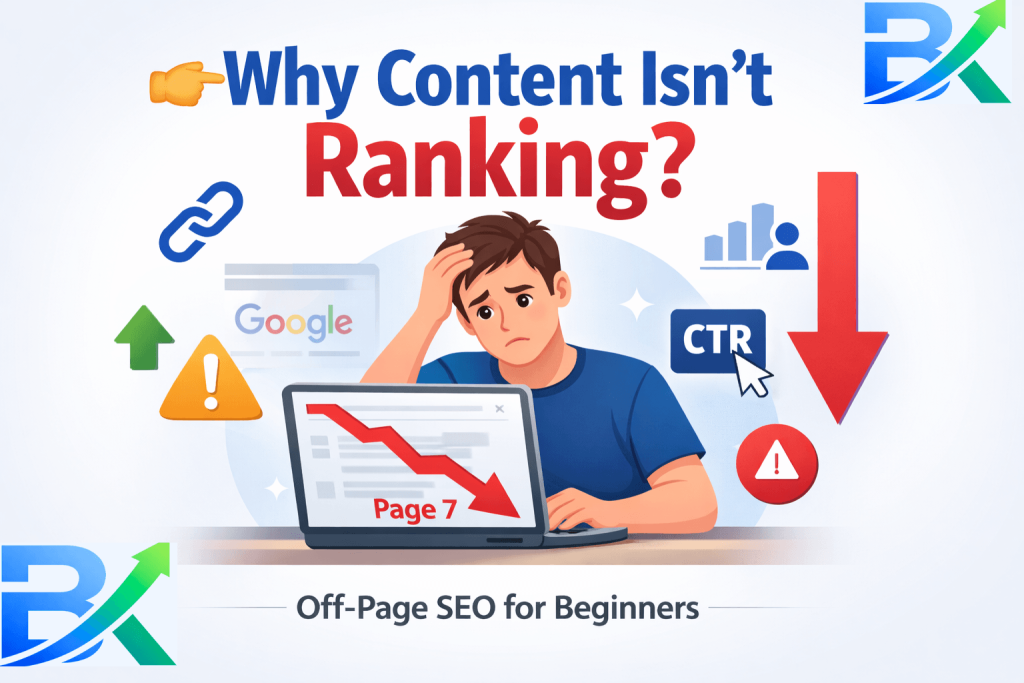
CTR, or click-through rate, measures how many users click your page after seeing it in Google search results.
A strong CTR tells Google that users find your content attractive and relevant.
Improving CTR is one of the fastest SEO improvements beginners can make.
You can improve CTR by:
- writing emotional titles,
- using numbers,
- adding power words,
- improving meta descriptions,
- and using schema markup.
For example:
❌ SEO Tips for Beginners
✅ 7 Powerful SEO Tips for Beginners That Actually Work in 2026
Even small title improvements can increase traffic significantly over time.
Common Off-Page SEO for Beginners Mistakes
When I first started learning SEO, I made several mistakes that slowed my growth.
Focusing Only on Backlink Quantity
Hundreds of low-quality backlinks rarely help long-term rankings.
Ignoring CTR
Many beginners forget that titles and user clicks strongly influence search visibility.
Spamming Communities
Dropping links everywhere damages reputation and trust.
Ignoring Brand Building
Google increasingly rewards real brands and trusted creators.
Neglecting User Experience
Slow websites and weak introductions increase bounce rates and reduce rankings.
Avoiding these beginner mistakes can save months of frustration and help your SEO grow more naturally and safely.
Why Most Beginners Fail at Off-Page SEO
When I first started learning off-page SEO, I made the same mistake many beginners make:
I focused on shortcuts.
I tried:
- random directory submissions,
- useless link exchanges,
- spammy comments,
- low-quality backlink sites.
None of them worked.
Some probably hurt my website.
Eventually I realized something important:
Google rewards reputation, not manipulation.
That changed everything.
The safest and most effective off-page SEO strategy is becoming genuinely useful in your niche.
When people trust your content:
- they link to it,
- share it,
- mention it,
- and return to it.
That creates long-term rankings.
Now let me show you the exact strategies that helped me most.
Strategy 1: Build High-Quality Backlinks
Backlinks are still one of the strongest ranking signals in Google.
A backlink simply means another website links to your content.
Google sees those links as recommendations.
But here is the part beginners misunderstand:
Quality matters far more than quantity.
One backlink from a trusted website in your niche can outperform hundreds of weak backlinks from random websites.
I learned this personally.
At one point I had dozens of low-quality backlinks that did almost nothing.
Later, I earned only three relevant backlinks from trusted blogs — and those three links improved my rankings noticeably.
That was when I understood the real power of quality backlinks.
Best Beginner Backlink Strategies
Create Linkable Content
The easiest way to earn backlinks naturally is creating content people genuinely want to reference.
The best linkable content usually includes:
- detailed guides,
- original experiences,
- statistics,
- tutorials,
- infographics,
- step-by-step processes.
Instead of publishing average content, create the article people bookmark.
That is what earns natural links over time.
Guest Posting
Guest posting still works extremely well in 2026 when done correctly.
Write useful articles for real blogs in your niche.
In return:
- you gain exposure,
- build relationships,
- and often receive a backlink.
But avoid spammy guest posting websites created only for links.
Focus on real audiences.
Broken Link Building
This strategy is beginner-friendly and underrated.
Find:
- broken links on websites in your niche,
- create similar useful content,
- then politely suggest your article as a replacement.
You help the website owner fix a problem while earning a backlink.
Win-win.
Journalist Outreach
Platforms like Connectively (HARO Alternative) allow journalists to request expert opinions.
When you provide valuable answers:
- your quote may appear in articles,
- and you often receive high-authority backlinks.
These links are extremely powerful.
Strategy 2: Improve Your CTR (Click-Through Rate)
This strategy surprised me the most.
CTR means:
how many people click your result after seeing it in Google search.
Google pays attention to this behavior.
If users consistently choose your result over others nearby, Google learns that your page may satisfy searchers better.
That can improve rankings over time.
How I Improved My CTR
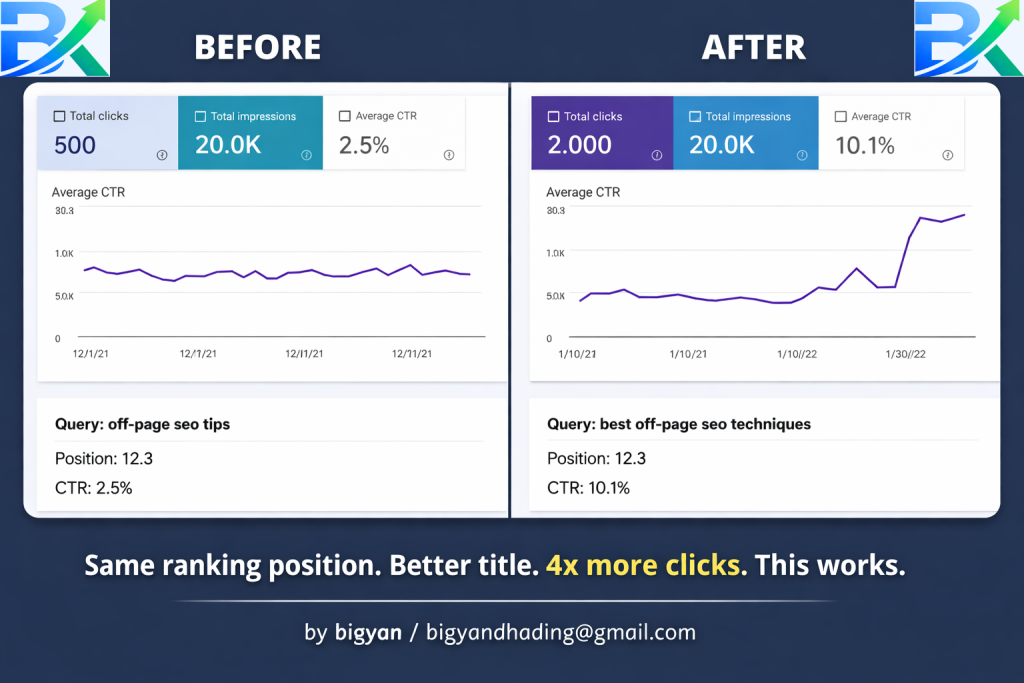
The first thing I changed was my titles.
Old title:
- “SEO Tips for Beginners”
Improved title:
- “7 Powerful SEO Tips for Beginners That Actually Work in 2026”
The second title creates more curiosity and stronger emotional interest.
That difference matters.
Ways to Improve CTR
Write Better Titles
Strong titles usually include:
- numbers,
- power words,
- clear benefits,
- emotional triggers,
- current year.
Examples:
- Proven
- Powerful
- Simple
- Beginner-Friendly
- Step-by-Step
Improve Meta Descriptions
Your meta description should make readers think:
“This is exactly what I need.”
Focus on benefits, not keyword stuffing.
Use Schema Markup
Schema helps create:
- FAQ snippets,
- star ratings,
- article enhancements,
- rich search results.
Rich snippets attract more clicks.
Plugins like:
make this easy for beginners.
Monitor Search Console
Google Search Console is one of the most important free SEO tools.
Look for:
- high impressions,
- low CTR pages.
Those pages are huge opportunities.
Sometimes changing only the title can improve rankings significantly within weeks.
Strategy 3: Build Strong Brand Signals
This is one of the most overlooked SEO strategies today.
7 Long-Tail Keywords for Beginners to Get Traffic Fast
Google increasingly wants to rank real brands and trusted entities.
That means your online presence matters.
What Are Brand Signals?
Brand signals include:
- branded searches,
- online mentions,
- consistent profiles,
- audience recognition,
- community trust.
When people search specifically for your name or blog name, Google notices.
It sees that your website has recognition.
That builds authority.
How Beginners Can Build Brand Signals
Be Consistent Everywhere
Use the same:
- profile photo,
- blog name,
- author name,
- bio,
- branding style.
Consistency helps Google connect all your profiles together.
Build Social Presence
You do not need every social platform.
Choose one or two platforms where your audience exists.
For bloggers:
- LinkedIn,
- Facebook,
- Pinterest,
- YouTube,
- and X/Twitter
can all help increase visibility.
Encourage Branded Searches
When people remember your blog name and search for it directly, that becomes a strong trust signal.
That is why creating memorable content matters.
Strategy 4: Improve User Behavior Signals
This is where many rankings quietly improve or collapse.
Google watches how users behave after clicking your page.
Signals include:
- bounce rate,
- dwell time,
- session duration,
- pages visited,
- engagement.
If visitors leave immediately, Google may interpret that as dissatisfaction.
If visitors stay and continue exploring your website, that sends positive quality signals.
What Helped Me Most
Better Introductions
I noticed many visitors left during the first 10 seconds.
So I rewrote my introductions to:
- hook attention quickly,
- answer immediately,
- avoid long boring openings.
Bounce rates improved noticeably.
Internal Linking
Adding relevant internal links increased:
- time on site,
- page views,
- user engagement.
Internal links help both SEO and readers.
Faster Page Speed
Slow pages destroy engagement.
According to research from Google PageSpeed Insights, even small delays can increase bounce rates significantly.
Compress images.
Use fast hosting.
Avoid heavy unnecessary plugins.
Speed matters.
Strategy 5: Guest Posting the Right Way
Guest posting still works when done properly.
But many beginners approach it incorrectly.
They focus only on getting backlinks.
That mindset usually leads to spammy opportunities.
The better approach is:
focus on audience and relationships first.
My Guest Posting Lessons
Relevance Matters More Than Domain Authority
A small but highly relevant blog often provides more SEO value than a huge unrelated website.
Google values topical relevance.
Study the Blog Before Pitching
Before sending guest post requests:
- read their content,
- understand their audience,
- identify missing topics.
Personalized pitches work far better.
Write Exceptional Content
Your guest article represents your reputation.
Make it genuinely useful.
A great guest post can:
- send referral traffic,
- create partnerships,
- generate future backlinks naturally.
Strategy 6: Participate in Communities
This strategy helped me build recognition faster than I expected.
Before I had strong backlinks, I started participating genuinely in online communities.
I answered questions.
Shared experiences.
Helped beginners.
Over time:
- people recognized my name,
- visited my blog,
- and shared my content naturally.
Best Beginner Communities
Find relevant subreddits and contribute genuinely.
Do not spam links.
Help first.
Quora
Detailed answers can bring:
- traffic,
- brand visibility,
- authority signals.
Facebook Groups
Helpful participation builds relationships and recognition.
Blog Comments
Thoughtful comments on niche blogs can help build connections with other creators.
Strategy 7: Build Trust and Reputation
Google increasingly evaluates trust.
👉 You can read the full detailed guide here:
Off-Page SEO for Beginners — Complete Guide
Especially after the rise of AI-generated low-quality content.
That means:
- author reputation,
- transparency,
- experience,
- and credibility
matter more than ever.
How I Improved Trust Signals
Added a Real Author Bio
This helped my site feel more trustworthy immediately.
Include:
- real photo,
- experience,
- niche expertise,
- links to profiles.
Shared Real Experiences
Google values real human experience heavily now.
Instead of generic advice:
- share personal lessons,
- failures,
- results,
- screenshots,
- examples.
That creates authenticity.
Build E-E-A-T Signals
Google’s E-E-A-T framework focuses on:
- Experience
- Expertise
- Authoritativeness
- Trustworthiness
Everything in modern SEO connects back to trust.
Common Off-Page SEO Mistakes Beginners Make
Chasing Spammy Backlinks
Cheap backlinks usually create long-term problems.
Avoid:
- link farms,
- spam directories,
- automated backlinks.
Ignoring CTR
Sometimes rankings improve simply by rewriting titles better.
CTR optimization is one of the fastest SEO wins available.
Posting Links Everywhere
Communities hate spam.
Build trust first.
Links second.
Ignoring Author Identity
Anonymous websites struggle more today.
Build a real online identity.
How Long Does Off-Page SEO Take?
This is the honest answer:
Off-page SEO is slow at first.
But once authority grows, results compound.
Typical timeline:
| Timeframe | Expected Results |
|---|---|
| 1–4 weeks | CTR improvements may appear |
| 1–3 months | Early backlinks and mentions |
| 3–6 months | Noticeable authority growth |
| 6–12 months | Strong ranking improvements |
| 12+ months | Faster rankings for new content |
Consistency matters more than speed.
Frequently Asked Questions About Off-Page SEO
Is off-page SEO still important in 2026?
Yes. Backlinks, brand mentions, and engagement signals remain major ranking factors.
Can I rank without backlinks?
For low-competition keywords, yes.
For competitive topics, backlinks and authority usually become necessary.
What is the safest backlink strategy?
Creating genuinely useful content and earning editorial backlinks naturally.
How many backlinks do beginners need?
There is no exact number.
Sometimes:
- 5 relevant backlinks outperform 100 weak backlinks.
Quality always matters more.
Final Thoughts
When I first learned off-page SEO, it felt overwhelming.
Backlinks.
CTR.
Brand signals.
Community building.
User behavior.
It seemed impossible to manage everything.
But I eventually realized something important:
You do not grow authority overnight.
You grow it consistently.
One useful article.
One helpful comment.
One better title.
One relationship.
One backlink.
Over time those small actions compound into real rankings.
That is how authority is built.
Not through shortcuts.
Not through spam.
But through trust.
And honestly, that is what makes modern SEO better than it used to be.
Because beginners can still compete when they focus on genuinely helping people.
I am still learning every week myself.
And that is exactly why SEO remains exciting.
- 📖 9 Proven Keyword Research Steps for Beginners
- 📖 7 Long-Tail Keywords for Beginners to Get Traffic Fast
- 📖 7 Powerful Off-Page SEO for Beginners — Full Guide
Beginner Off-Page SEO Checklist
Backlinks
- Create one linkable article monthly
- Reach out to relevant blogs
- Try broken link building
- Build genuine niche relationships
CTR
- Rewrite weak titles
- Improve meta descriptions
- Add schema markup
- Monitor Search Console
Brand Signals
- Keep branding consistent
- Grow social presence
- Encourage branded searches
- Build recognition gradually
User Behavior
- Improve introductions
- Add internal links
- Increase page speed
- Match search intent carefully
Helpful SEO Resources
- Google SEO Starter Guide
- Moz Beginner SEO Guide
- Google Search Console
- Google PageSpeed Insights
- Ahrefs Blog
Did this guide help you? Share your biggest off-page SEO struggle in the comments below. I read every comment personally.
These relationships turned into backlinks, shares, and opportunities I could never have gotten through cold outreach.

Pingback: 5 Core SEO Ranking Factors: Keywords, Quality Content, CTR, User Behavior & Backlinks (Beginner’s Guide)
Pingback: 3 Proven & Effective Best Free SEO Tools for Beginners to Grow Traffic Fast (No Cost)
Pingback: 7 Deadly Common SEO Mistakes Beginners Make (Fix These Before It’s Too Late!)