Table of Contents
- What Are Keywords? A Simple Explanation for Beginners
- Why You Need Keyword Research as a Beginner
- Step 1: Start with Seed Keywords
- Step 2: Use Free Tools to Find More Keywords
- Step 3: Understand the Numbers That Matter
- Step 4: Find Long-Tail Keywords
- Step 5: Check Ranking Difficulty
- Step 6: Organize Your Keywords
- Step 7: Place Your Focus Keyword
- Step 8: Write High-Quality Content
- Step 9: Track Your Progress
- Common Mistakes to Avoid
- Action Plan for Beginners
Let me tell you a quick story.
👉 New to SEO? Start with this simple beginner guide:
https://bigyankhadkacom.com/seo-for-beginners/
A few years ago, I started my first blog. I was excited. I had big dreams. I wrote article after article, pouring my heart into every word. I hit publish with so much hope.
Then nothing happened.
Days turned into weeks. Weeks turned into months. The only person reading my blog was my mom. And honestly, I think she was just being nice.
I was frustrated. I felt like I was shouting into an empty room. I almost gave up completely.
But then someone told me about keyword research for beginners. At first, I thought it sounded technical and boring. But I was desperate, so I gave it a try.
And wow. Everything changed.
Suddenly, I understood what people were actually searching for. I stopped guessing and started writing about topics people genuinely wanted to read. My traffic grew. My audience grew. I finally felt like I was building something real.
Today, I want to share exactly what I learned with you. No complicated jargon. No fluff. Just a simple, step-by-step guide to keyword research for beginners that actually works.

What Are Keywords? A Simple Explanation for Beginners
Before we dive into the steps, let us get clear on the basics.
Keywords are simply the words and phrases that people type into Google when they have a question or a problem.
Think about yourself. When you want to know something, what do you do? You grab your phone and type a few words into Google. Those words? Those are keywords.
Here are some examples:
👉 Learn keyword research for beginners step by step here:
https://bigyankhadkacom.com/keyword-research-for-beginners/
- Someone wants to bake a cake: “easy chocolate cake recipe”
- Someone has a sore back: “how to fix lower back pain fast”
- Someone needs a gift: “best coffee maker under 100 dollars”
Every single one of those searches is a keyword. And every single one represents a real person looking for an answer.
When you understand keyword research for beginners, you learn how to find those questions and write content that answers them. Then Google shows your article to those people. They click. They read. They become your audience.
It is really that simple.
Why You Absolutely Need Keyword Research as a Beginner
When you are new, nobody knows you exist. You have zero traffic. Zero readers. Zero credibility.
Keyword research for beginners is your way out of that situation. Here is why it matters so much.
It Takes the Guesswork Out of Blogging
Most beginners sit down and think, “Hmm, what should I write about today?” They guess. And usually, they guess wrong. They write about what they think is interesting, not what their audience is actually looking for.
Keyword research fixes that. It shows you exactly what people are searching for. You stop guessing and start writing with confidence.
It Brings Free Traffic
When you rank on Google for a keyword, people click your link. That traffic is free. You do not pay for ads. You do not beg for shares. You just show up when people are looking for answers.
And here is the beautiful part: once you rank, the traffic keeps coming. I have articles I wrote three years ago that still bring me visitors every single day. All because I did proper keyword research for beginners before I wrote them.
It Helps You Beat Big Websites
You cannot compete with Forbes or The New York Times for broad terms like “health” or “travel.” They have teams of writers and decades of authority.
But you can compete for specific, detailed keywords. Things like “best hiking boots for flat feet under 100 dollars” or “how to start a food blog with no money.” Those keywords are winnable. And that is where smart keyword research for beginners comes in.
Step 1: Start with Seed Keywords
Every keyword research journey starts with seed keywords. These are the big topics that describe your niche.
Let us say you want to start a blog about indoor gardening. Your seed keywords might be:
- Indoor plants
- Houseplants
- Plant care
- Beginner plants
- Low light plants
Grab a notebook right now. Write down 5 to 10 broad topics related to your blog. Do not overthink it. Just get the ideas out of your head.
This is the foundation of keyword research for beginners. Everything else builds from here.
Explore additional insights at the Search Engine Journal SEO Guide.
Step 2: Use Free Tools to Find More Keywords
Now it is time to turn those seed keywords into a huge list of actual keywords that people search for. You do not need expensive software. These free tools are more than enough to get started.
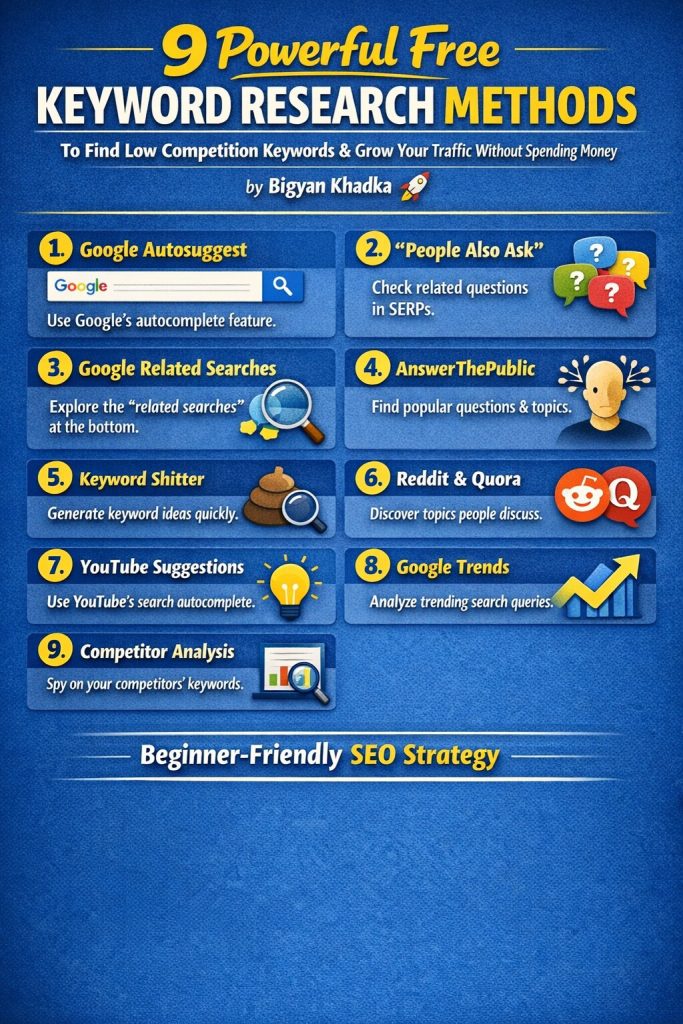
Google Autocomplete
Go to Google. Start typing one of your seed keywords slowly. Do not press enter. Just watch what Google suggests.
If I type “indoor plants,” Google might show:
- indoor plants low light
- indoor plants for beginners
- indoor plants safe for cats
- indoor plants that clean the air
Each of those is a real search from a real person. Write them down.
Answer the Public
This is one of my favorite free tools. Go to answerthepublic.com and type in your seed keyword.
It will show you every question people ask about that topic:
- how often to water indoor plants?
- why are my indoor plants dying?
- what is the best soil for indoor plants?
These questions make perfect blog post titles. People search for questions constantly.
Google Search Console
If you already have a website, even a new one, set up Google Search Console. It is free. It shows you what keywords people are already using to find your site. This is gold for keyword research for beginners.
👉 Understand why SEO is important for websites:
https://bigyankhadkacom.com/why-seo-is-important-for-websites/
Step 3: Understand the Numbers That Matter
When you start looking at keyword lists, you will see numbers. Let me explain what they mean in simple terms.
Search Volume
This is how many people search for that keyword every month.
- High (10,000+): Very popular. Very hard to rank for.
- Medium (1,000 to 10,000): Good keywords. You can target these as you grow.
- Low (100 to 1,000): This is your sweet spot as a beginner. These are easier to rank for, and the people searching are usually very interested in exactly what you offer.
Keyword Difficulty
This tells you how hard it is to rank on the first page of Google.
- Easy (0 to 30): Perfect for beginners. Go after these.
- Medium (31 to 60): You can try these after you have some articles published.
- Hard (61 to 100): Avoid these when you are starting. Big websites dominate them.
Search Intent
This is the reason behind the search. If you get this wrong, you will never rank.
- Informational: The person wants to learn something. (e.g., “how to propagate a succulent”)
- Commercial: The person is researching before buying. (e.g., “best grow lights for succulents”)
- Transactional: The person is ready to buy. (e.g., “buy succulent soil online”)
As a beginner, focus on informational keywords. You are building trust and teaching people.
Step 4: Hunt for Long-Tail Keywords
If you take one thing away from this guide, let it be this: long-tail keywords are your best friend.
Long-tail keywords are longer, more specific phrases. They have lower search volume, but they are much easier to rank for. And the people who search for them know exactly what they want.
Compare these:
- Short-tail (hard): “Running shoes”
- Long-tail (easier): “Best running shoes for flat feet women”
- Short-tail (hard): “Pasta recipe”
- Long-tail (easier): “Easy gluten free pasta recipe for kids”
Do you see the difference? The long-tail keywords are more specific. They have less competition. And they attract exactly the right audience.
This is the secret weapon of keyword research for beginners.
Step 5: Check If You Can Actually Rank
Before you spend hours writing an article, do a quick check. It takes two minutes and saves you so much frustration.
Type your keyword into Google. Look at the first page.
Ask yourself these questions:
- Are the top results huge websites? If you see Forbes, Amazon, Wikipedia, or major news sites, skip this keyword for now.
- Are there forums like Reddit or Quora on the first page? This is actually a good sign. It means the topic is not super competitive.
- Do the top articles look good? If they are short, outdated, or poorly written, you have a chance. You can write something better.
Your goal is to find keywords where the top results are okay, but not amazing. Then you write something truly helpful and beat them.

Step 6: Organize Your Keywords Like a Pro
Once you have a list of 20 to 50 keywords, take a few minutes to organize them. A simple table works great.
| Keyword | Volume | Difficulty | Intent | Priority |
|---|---|---|---|---|
| how to water succulents | 500 | Low | Informational | High |
| best soil for succulents | 300 | Medium | Commercial | Medium |
| buy succulent online | 100 | High | Transactional | Low |
Group similar keywords together. If you have five keywords about watering succulents, write one comprehensive guide called “The Ultimate Guide to Watering Succulents” and use all five keywords inside it.
This is a pro tip for keyword research for beginners. It saves time and helps you rank faster.
Step 7: Place Your Focus Keyword in the Right Spots
Once you choose your main keyword, use it in the right places. This tells Google and your readers what your article is about.
In Your H2 Subheadings
Use your focus keyword in at least one H2 or H3 subheading. Throughout this article, I have used keyword research for beginners in multiple subheadings so it is clear what we are covering.
In the First 100 Words
Mention your keyword naturally in the first paragraph. This helps readers know immediately that they are in the right place.
In the URL
Keep your URL short and include your focus keyword.
- Good:
yourwebsite.com/keyword-research-for-beginners - Bad:
yourwebsite.com/12345-random-article
In the Meta Description
This is the short description under your title on Google. Include your keyword to encourage people to click.
Throughout the Body
Use your keyword naturally throughout the article. A good rule is once every 200 to 300 words. Do not force it. If it sounds awkward, leave it out.
Step 8: Write Content That People Actually Want to Read
Keywords bring people to your site. But your content keeps them there.
If someone clicks on your article because they searched for keyword research for beginners, and your article does not actually help them, they will leave. That tells Google your site is not useful.
Here is how to write content people love:
- Write like you talk. Use short sentences. Imagine you are explaining something to a friend.
- Use lists. Bullet points and numbered lists are easy to read.
- Add images. Use images with descriptive alt text. For example, the images in this guide use alt text like “keyword research for beginners on a laptop.”
- Be thorough. Answer every question your reader might have. Leave nothing unclear.
When you truly help people, Google notices. Your rankings improve. Your traffic grows.
Step 9: Track Your Progress and Keep Going
Keyword research for beginners is a skill. You get better with practice.
After you publish an article, it might take weeks or months to rank. That is normal. Do not panic.
How to track your progress:
- Search Google for your keyword every few weeks.
- See if your article is moving up.
- If you are not ranking after three months, update your article. Add more detail. Add better images. Make it even more helpful.
Every article you write teaches you something. Keep going.
Learn SEO fundamentals from the Moz Beginner SEO Guide.
5 Mistakes Beginners Make (And How to Avoid Them)
I made all of these mistakes so you do not have to.
1. Going after keywords that are too hard.
Avoid one-word keywords. Go for longer, more specific phrases.
2. Ignoring search intent.
If someone searches “buy laptop,” do not write about “the history of laptops.” Match what people actually want.
3. Writing for Google instead of humans.
Write for real people. Help them solve a problem. Google will reward you.
4. Overcomplicating the process.
You do not need expensive tools. A notebook, Google, and Answer the Public are enough.
5. Giving up too soon.
SEO takes time. Do not expect overnight results. Keep writing. Keep learning.

Your Action Plan for Today
You do not need to be an expert. You just need to start.
Here is exactly what to do today:
- Write down 5 seed keywords for your niche.
- Go to Google and see what autocomplete suggests. Write down 5 ideas.
- Pick one long-tail keyword that is a question. Look for “how to,” “what is,” or “best way to.”
- Write a 500-word article answering that question as thoroughly as you can.
- Use your focus keyword in your title, one H2 subheading, and the first paragraph.
That is it. That is your first real step into keyword research for beginners.
Final Thoughts
When I started, I had no traffic, no audience, and no idea what I was doing. Learning keyword research for beginners changed everything for me and improved my SEO performance. It took me from writing to an empty room to building a blog that people actually read and engage with.
This clearly shows why keyword research for beginners is essential for improving search rankings, user behavior, and overall content quality. When you target the right keywords, you attract the right audience, increase CTR (click-through rate), and boost your website’s visibility on Google.
You can do the same.
It does not require genius-level skills. It requires consistency, smart keyword selection, and high-quality content. Pick one keyword, understand search intent, and write one helpful article. Focus on creating value, improving on-page SEO, and building content that naturally earns backlinks over time.
As your content quality improves, so does your user engagement, dwell time, and rankings. Google rewards helpful content that satisfies users.
Before you know it, your small blog will grow, rank, and attract consistent traffic.
Now go start your keyword research, focus on quality, and stay consistent. I am rooting for you 🚀